ISO 7886 Syringe Leak Testing: Method, Procedure and Guide
ISO 7886
Syringe Leak Testing
Tietoja
Ruiskun vuototesteri
For disposable and reusable syringes, maintaining a reliable seal is essential for safe fluid handling, accurate delivery, and consistent product performance. ISO 7886 provides an important framework for evaluating manually operated syringes intended for medical use. Among its test methods, the vacuum-based procedure in ISO 7886-1 is particularly useful for evaluating air leakage past the plunger stopper and determining whether the plunger stopper can separate from the plunger.

Ruiskujen vuotojen havaitseminen
ISO 7886-1 and the Purpose of Syringe Leak Testing
ISO 7886-1 covers manually operated syringes intended for medical use. The standard establishes requirements and test methods that help manufacturers evaluate important functional characteristics of syringes.
One important concern involves the integrity of the plunger stopper and its sealing interface with the syringe barrel. During aspiration, a syringe operates under negative pressure. If the seal does not maintain sufficient integrity, air may enter the syringe through the plunger area. This can affect fluid aspiration and may indicate inadequate sealing performance.
The vacuum procedure within ISO 7886 specifically examines two related conditions:
- Leakage of air past the plunger stopper or seal(s)
- Separation of the plunger stopper from the plunger
These characteristics matter because the syringe must maintain its intended sealing performance while the plunger moves through the barrel.
A controlled syringe test therefore provides more useful information than simply checking the syringe for visible defects. By applying a defined vacuum and monitoring pressure behavior, the test can identify leakage that may not be apparent during visual inspection.
Ruiskujen vuotojen havaitseminen
Vacuum Leak Tester for ISO 7886 Testing
A Vacuum Leak Tester used for this application needs to generate, control, and measure negative pressure accurately. According to the ISO 7886-1 vacuum test principle, the syringe nozzle connects to a compatible fitting while the plunger remains fixed at a specified position.
The basic test system includes several important components:
01
Vacuum generation system:
Creates the negative pressure required for the test.
02
Pressure measurement system:
A manometer or equivalent device monitors the vacuum level and detects pressure changes during the observation period.
03
Vacuum-tight valve system:
Allows the syringe and measuring system to be isolated after the required vacuum has been established.
04
Compatible connection:
The syringe nozzle connects to the test system through an appropriate conical fitting.
01
Plunger support:
Holds the plunger in a fixed position while the vacuum acts on the syringe.
The design of the testing system directly affects repeatability. If the external tubing or connections introduce unintended leakage, the measured pressure change may not represent leakage from the syringe itself. Therefore, the complete test setup should be checked before routine testing.
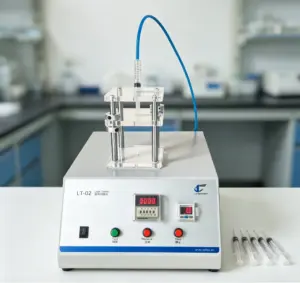
For laboratories that need a dedicated solution for leak testing syringes, the Cell Instruments SLT-02 ruiskun vuototesteri can be integrated into a controlled quality-control workflow. Its application is particularly relevant when manufacturers need a repeatable vacuum-based method for assessing syringe sealing performance rather than relying solely on manual inspection.
What Should Be Recorded in an ISO 7886 Syringe Test?
A useful syringe test should produce traceable results rather than a simple pass/fail statement without supporting information.
The test report should include key information such as:
| Test Item | Information to Record |
|---|---|
| Syringe identification | Product identity and nominal capacity |
| Leakage | Whether leakage past the plunger stopper or seal(s) was observed |
| Pressure change | Any fall in manometer reading during the observation period |
| Plunger stopper | Whether separation occurred |
| Test date | Date of testing |
For production quality control, manufacturers can also record sample identification, test equipment identification, operator information, environmental conditions, and relevant batch information.
Consistent documentation makes trends easier to identify. If pressure loss gradually increases across production batches, for example, the result may justify an investigation into sealing dimensions, barrel quality, stopper materials, assembly conditions, or process variation.
Cell Instruments SLT-02 Syringe Leak Tester
Improving Test Consistency with a Dedicated Syringe Leak Tester
Applications of ISO 7886 Leak Testing
The method can support several stages of syringe development and manufacturing.
During research and development, engineers can use vacuum testing to compare different plunger stopper designs, sealing geometries, and material combinations.
During process validation, manufacturers can evaluate whether assembly parameters consistently produce an acceptable seal.
During incoming and production quality control, the test can help identify changes in sealing performance between batches.
Usein kysytyt kysymykset ruiskun vuototestistä
What is the purpose of the ISO 7886-1 syringe leak test?
The ISO 7886-1 test evaluates whether air leaks past the syringe plunger stopper during aspiration and whether the plunger stopper remains securely attached to the plunger under negative pressure.
How much water should be placed in the syringe before testing?
According to the referenced ISO 7886-1 procedure, the syringe should contain at least 25% of its nominal capacity with water before the vacuum test begins.
What vacuum level is used for the test?
The procedure described in ISO 7886-1 Annex B requires the pressure to reach approximately 88 kPa below ambient atmospheric pressure. A suitable syringe leak tester should therefore provide controlled vacuum conditions capable of reaching this test level.
How long should the vacuum be monitored?
After isolating the syringe and pressure measurement system, the vacuum condition is observed for 60 seconds, and any fall in the pressure reading should be recorded.
Can the Cell Instruments SLT-02 be used for ISO 7886-1 testing?
The Cell Instruments SLT-02 ruiskun vuototesteri provides controlled vacuum and programmable test timing and can support the vacuum and holding conditions required for ISO 7886-1-related syringe leak testing. Its test workflow can help laboratories perform repeated tests under more consistent conditions.


Ota yhteyttä
No. 5577 Gongyebei Rd, Licheng, Jinan, 250109, Shandong, Kiina.
trade@celtec.cn
+86 185 6001 3985
 FI
FI  EN
EN  AR
AR  BG
BG  CS
CS  DA
DA  DE
DE  EL
EL  ES
ES  ET
ET  FR
FR  HU
HU  ID
ID  IT
IT  JA
JA  KO
KO  LT
LT  LV
LV  NB
NB  NL
NL  PL
PL  PT
PT  RO
RO  RU
RU  SK
SK  SL
SL  SV
SV  TR
TR  UK
UK