
Syringe functionality testing is a critical quality assurance activity in the medical and pharmaceutical industries. Syringes are directly involved in drug delivery, and any failure in sealing, plunger movement, or structural integrity can compromise patient safety. Through systematic syringe functionality testing, manufacturers and quality control laboratories verify that syringes perform as intended under real use conditions.
This article provides a comprehensive introduction to syringe functionality testing, explains relevant test principles, and connects international standards with practical laboratory operations. It is designed to help medical device professionals understand how to conduct reliable syringe tests while meeting regulatory expectations.
ISO 7886-1 and Syringe Test Requirements
ISO 7886-1 serves as the primary international standard for sterile hypodermic syringes intended for single use. It defines essential performance requirements related to dimensions, materials, freedom from leakage, and functional safety. Within this framework, syringe functionality testing focuses strongly on leakage performance, plunger behavior, and resistance to separation during aspiration.
A syringe test performed with a vacuum leak tester evaluates the ability of the plunger stopper and sealing system to prevent air ingress when negative pressure is applied. This test simulates aspiration conditions encountered during clinical use and directly reflects syringe reliability.
By aligning testing procedures with ISO 7886-1, laboratories ensure that results remain consistent, traceable, and acceptable to regulatory authorities.
Why Syringe Functionality Testing Is Essential
Syringes may appear simple, but their functional performance depends on precise interactions between barrel, plunger, and stopper. Syringe functionality testing helps identify risks that visual inspection cannot detect.
Key objectives include:
- Verifying airtight sealing during aspiration
- Preventing unintended detachment of plunger stopper
- Ensuring consistent plunger movement
- Supporting batch release and compliance documentation
Failures in these areas can lead to dosing inaccuracies, contamination risks, or product recalls. For this reason, syringe functionality testing forms a core part of medical device quality systems.
Principle of the Vacuum Leakage Syringe Test
According to ISO 7886-1 Annex B, the vacuum leakage test applies controlled negative pressure through the syringe nozzle while the syringe contains a defined volume of water. The test examines whether air leaks past the plunger stopper or seal and whether the stopper separates from the plunger under stress.
During this syringe test:
- A partial vacuum challenges the sealing interface
- Pressure stability indicates sealing performance
- Any pressure drop suggests leakage or mechanical weakness
This approach provides a non-destructive, highly sensitive method for evaluating syringe functionality.
Test Apparatus and Key Conditions
A reliable syringe functionality testing setup includes several critical components:
- A compatible connector in accordance with ISO 80369-7
- A secure clamping device to fix the plunger position
- A calibrated vacuum generation and measurement system
- Distilled water within a controlled temperature range
Using a professional vacuum leak tester ensures stable pressure control and accurate monitoring throughout the test duration. Equipment quality directly affects test repeatability and confidence in results.
Role of Instrumentation in Reliable Testing
Accurate syringe functionality testing depends on precise and repeatable instrumentation. Advanced systems reduce operator variability and improve detection sensitivity.
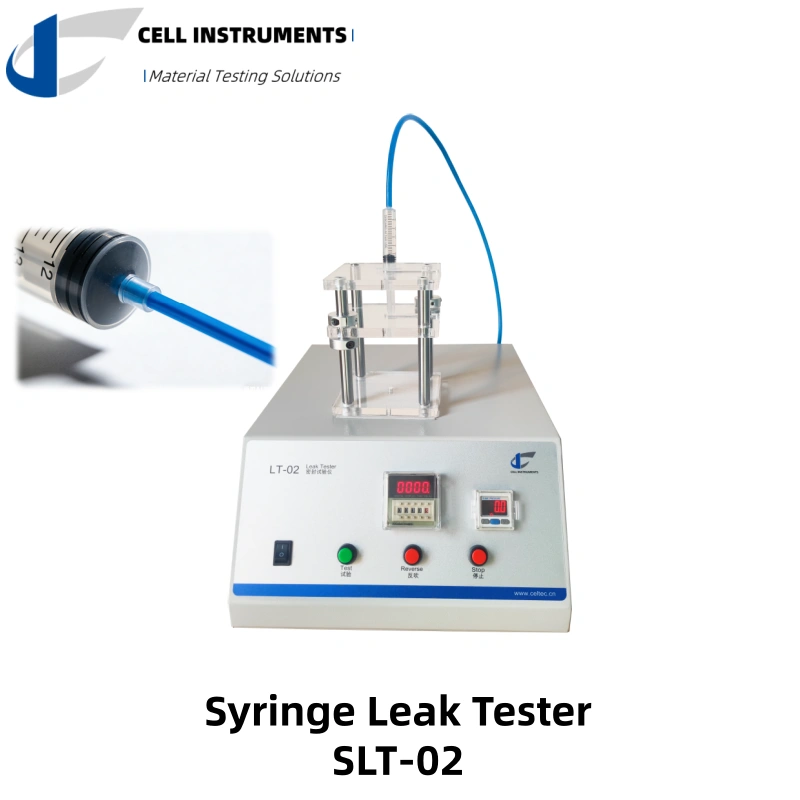
The Cell Instruments SLT-02 Tester de scurgere a seringii offers a professional solution for laboratories performing routine syringe tests. It supports stable vacuum control, sensitive pressure measurement, and efficient workflow design, making it suitable for both development and production quality control environments.
Applications Across Medical Device Manufacturing
Syringe functionality testing supports multiple stages of the product lifecycle:
- Design validation and verification
- Incoming material inspection
- Routine batch quality control
- Process optimization
- Regulatory submissions and audits
By integrating syringe functionality testing into standard quality practices, manufacturers strengthen product safety and regulatory confidence.
Conclusion
Syringe functionality testing plays a vital role in ensuring the safety and performance of medical syringes. Through standardized syringe test methods defined in ISO 7886-1 and supported by reliable vacuum leak tester systems, manufacturers can detect leakage risks and mechanical weaknesses before products reach patients. With professional equipment and disciplined procedures, syringe functionality testing becomes a powerful tool for quality assurance and long-term compliance.
 RO
RO  EN
EN  AR
AR  BG
BG  CS
CS  DA
DA  DE
DE  EL
EL  ES
ES  ET
ET  FI
FI  FR
FR  HU
HU  ID
ID  IT
IT  JA
JA  KO
KO  LT
LT  LV
LV  NB
NB  NL
NL  PL
PL  PT
PT  RU
RU  SK
SK  SL
SL  SV
SV  TR
TR  UK
UK